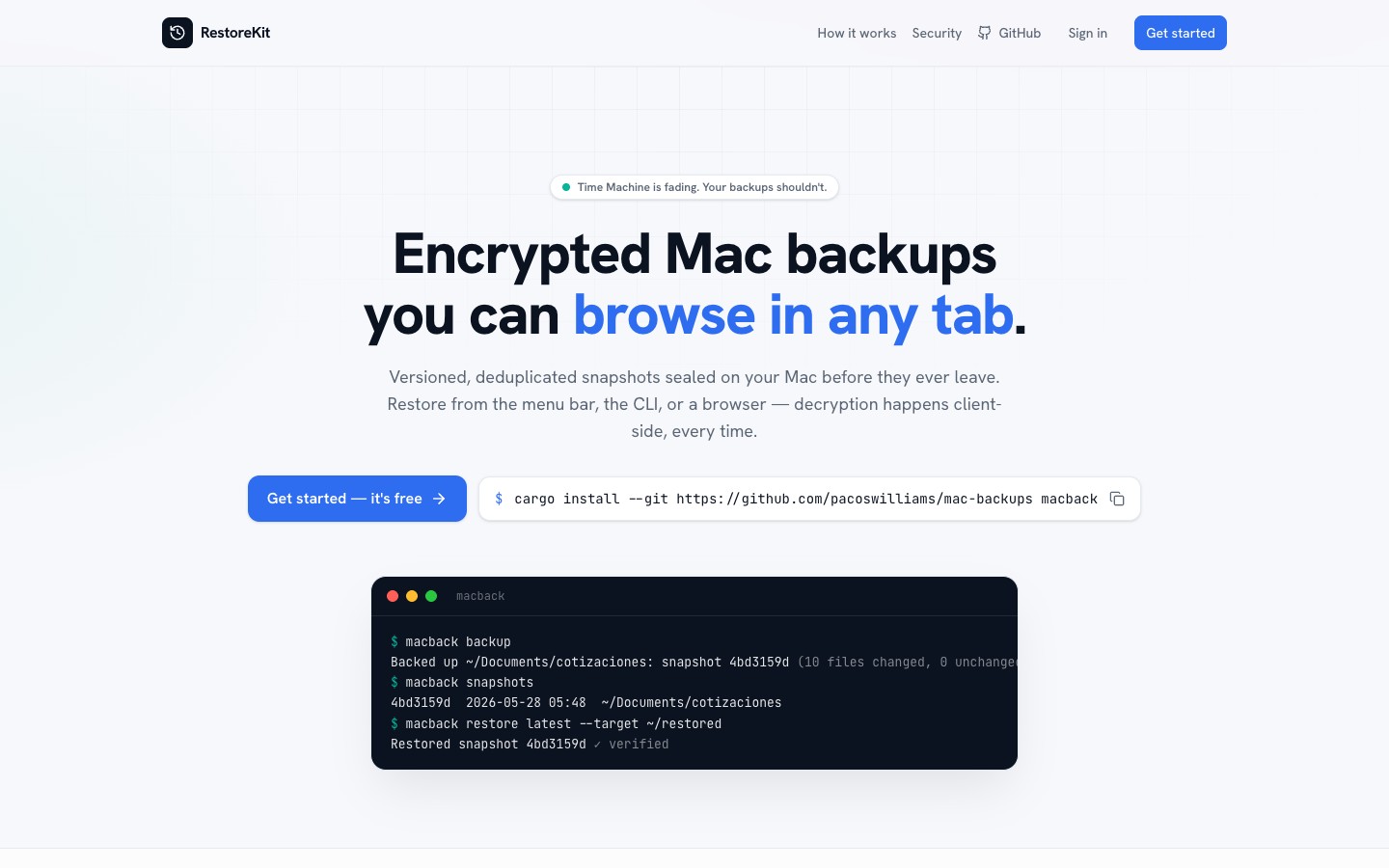
RestoreKit is a Time Machine alternative built from scratch in Rust: content-defined chunking, BLAKE3-addressed deduplication, and encrypted, versioned snapshots pushed to S3-compatible storage. You browse and restore any version from a browser tab — and decryption stays in-tab, so the server never sees your files.
The problem
Cloud backup usually means trusting a provider with plaintext access to everything you own. Local backups (like Time Machine) keep your data private but tie you to a single disk. RestoreKit aims for both: off-site, versioned, and zero-knowledge — the storage backend holds nothing but encrypted blobs.
How it works
- Content-defined chunking (FastCDC). Files are split on content boundaries, so a small edit re-uploads only the chunks that changed.
- BLAKE3-addressed dedup. Every chunk is named by its hash; identical data is stored once, across files and across snapshots.
- Encrypted snapshots. Chunks are encrypted client-side before they ever leave the machine and pushed to R2 / S3-compatible storage.
- In-tab restore. A WASM build decrypts and reassembles files inside the browser tab — the server only ever serves ciphertext.
Highlights
- Content-addressed and deduplicated by construction
- Versioned snapshots you can browse and restore from the web
- True zero-knowledge: decryption never leaves the client
Stack
A Rust core (FastCDC, BLAKE3) compiled to WASM for in-browser restore, R2 / S3 for storage, and a SvelteKit dashboard. Source on GitHub.